
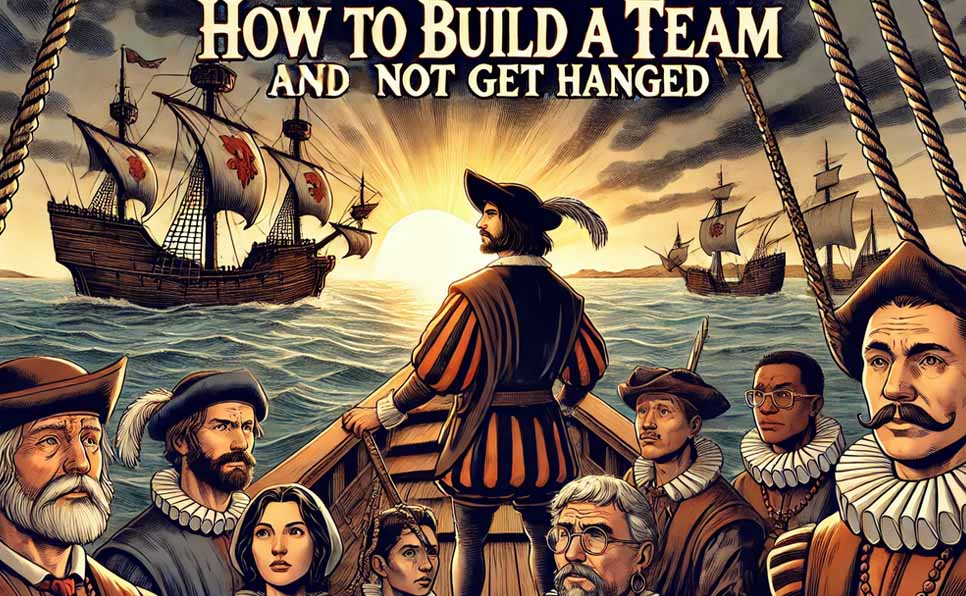
Why Do We Need Teams and How to Organize Them?
Imagine yourself as an explorer from the 15th century, with the intent of finding a new way to India. What do you need first? At least a ship and a little bit of insanity. Yes, yes, we can do a lot of things, but can you build the ship by yourself? Everything, from cutting trees to actually building the ships? Probably not, at least not me. But if you can gather a group of people with specialized skills, you can probably build the ship and try to find a new way to India.
This sounds great in theory, but how do you know which skills and how many people you need? Should they work as one big team, or should they be split into different teams? What puzzle pieces do you need to build a beautiful picture?
It’s easy, just clearly define what your end goal is, what you want to achieve, and then work backward to define the steps needed to reach the goal. Don’t go from the current state towards the goal, instead, go from the goal backward towards the current state.
Let’s say you want to sail to India. What do you need? Probably a ship and someone who knows how to sail. It seems we need two teams: a team to build the ship and a team to sail. But where is the border between these two teams? Are they independent? I’m not a sailing expert, but it’s probably smart to include sailing experts in the phase of building the ship and also to include shipbuilding experts as part of the sailing team for maintenance in case of emergencies. What does this mean? One big team? Or rather two multidisciplinary, independent teams?
In the Columbus example, we would probably have one shipbuilding team, which would, at some point, be transformed into a sailing team. Some team members would probably be replaced with people with more specialized sailing skills. The important message is that teams can change in shape and personnel, but they must remain as independent as possible to achieve their goals
Please note, there is no need for cartographers on the ship, just go straight west, and you should be fine.
What About the Resources?
How much food and how many tools do you need for the journey to India? Again, you need to focus on your end goal: reaching India. The reality is that, in the beginning, nobody knows how many days they will sail, but they have estimated how big Earth is. So, probably, they just did the math and estimated how many days they would need to sail across half of the globe and based on that did the math how much supplies they need.
This is very common in our modern world, we often don’t know exactly what resources we need, so we make an estimation.
Hopefully, you got the idea, define your goal and walk the walk backward, not forward.
Team Processes
Nice! We have a ship supplied with resources and men. Now what? Imagine being on Columbus’ ship, Santa Maria, which carried 40 men. What would that look like without clear orders and defined responsibilities? Probably a total mess.
For this reason, always make sure everyone has a clear understanding of what and when they should do something. In modern jargon, a team needs to have defined processes or a plan for how to get the job done.
Again, think backward, decide what needs to be done. What is the goal? Do we need to do some maintenance on the ship, clean it, or simply cook dinner? What is the easiest way to achieve a goal? Specify it clearly—what and why something needs to be done—and then just communicate it using simple but effective techniques covered in Effective Commanding: What do you really want?
Team morale
Now we have a ship with an organized and skilled team. Everything is perfect! Let’s sail into the uncharted oceans.
Not yet, sailor. We are still missing one major ingredient, we need to be sure that everyone on board, as individuals and as a team, has the mental strength, morale and motivation to achieve our goal: India. Otherwise, morale will drop drastically, and sailors will hang you, or, in the best case, they will leave you on a remote island.
Why did Columbus want to discover a new way to India? History books say he wanted to find a new, shorter route to India and also to expand Christianity.
How to have morale that will last long enough to reach a long voyage? The answer is a well-defined purpose. Everyone needs to be strongly committed to a common purpose, not only the what the goal is but also the why behind it. Purpose is like a morning star leading the ship toward the goal in the darkest night.
You can promise sailors wealth, Indian spices, and American gold, this will keep morale exceptionally high for sure, but what would happen if you won’t find wealth? If promises were broken? Probably, you would be hanged.
Probably you are asking yourself how to not get hanged?
For start, you must understand the inner values of the team and build a purpose around that. What did sailors really, really want? Only wealth? Or is there something more spiritual? Can they identify with the purpose of spreading Christianity? If yes, then the purpose is very easy to achieve, because at some point, we would either die at sea or find people we would try to convert.
Realistically, most sailors’ primary motivation was wealth. So, you can promise them wealth, but there is no way to be sure you can fulfill it. Have integrity, don’t promise people things you cannot fulfill, otherwise, guess what, you will be hanged. This or another way. Let’s say that wealth is the only possible purpose, which, you should not promise it but instead use a simple condition technique – Find a secondary purpose and transform it into primary:
“We cannot promise you wealth. It may or may not be found, we don’t know. But we will sail west into the unknown seas and try to find a new way to India. We guarantee that we will fairly share everything, from pain to glory and wealth, if we find it. Will you go with us on the greatest journey in human history?”
Honestly, I don’t have a clue if men from the 15th century would accept this as a purpose, but more important is to understand that every group of people needs a strong purpose that actually resonates with them and it can be achieved. Without purpose, or belief it can be achieved people would just ask themselves: Why are we doing this? And at some point, they would simply stop doing it.
Similar to defining purpose, defining values requires understanding what people really want and making sure values are respected. Do not lower standards. I did a little research and found that values important to sailors were loyalty, brotherhood, faith, shared rewards, honor, and reputation.
A strong purpose guides us long term, but short term values like loyalty and honor keep teams motivated daily.
It makes sense, sailing was extremely dangerous and sailors needed emotional insurance that, in case of problems, they wouldn’t be alone. Their brothers sailors on the ship and God would help them.
Let’s take a look at our purpose again:
“We cannot promise you wealth. It may or may not be found, we don’t know. But we will sail west into the unknown seas and try to find a new way to India. We guarantee that we will fairly share everything, from pain to glory and wealth, if we find it. Will you go with us on the greatest journey in human history?”
Do you see that this purpose is something bigger than us, finding a new way to India, does not promise wealth and at the same time, it covers some of the most important values for sailors? Brotherhood, glory and fairness. And that’s the whole point. Purpose is a long term goal closely aligned with values, which are short term daily goals.
Why purpose and values matters
Because a great purpose aligned with values creates an infinite internal source of motivation. And during the darkest hours, inner motivation can be the difference between life or death, success or failure.
Deep emotional connection to what we are doing today is more important than ever. Try it out, and we guarantee that you will reach your goal. But be prepared, sometimes, you don’t reach your goal. You don’t find Indian spices. Instead, you find American gold.